The New Hiring Equation: Speed, Signal, and Safeguards
TL;DR AI has reshaped the hiring landscape. But with new opportunities come new risks, namely candidate fraud. Today, TA leaders have a dual mandate: accelerate hiring and protect the funnel. The teams getting it right are boosting speed and signal with AI—while embedding safeguards that scale with risk and keep trust intact.
Recruiters today face two realities.
- AI has unlocked new opportunities to streamline processes, drive efficiency, and ultimately give recruiters more time to connect with real, qualified candidates.
- At the same time, it’s making it easier than ever for fraudulent applicants to game the system—creating real, increasing risk across hiring funnels.
The result? TA leaders are tasked with learning new technologies and enabling their teams to use them effectively, while simultaneously anticipating risk and putting the right safeguards in place to protect their hiring funnel and their organization.
In other words, they’re flying the plane while they build it.
To help teams navigate this dichotomy, we’re taking a high-level look at how AI can strengthen your recruiting strategy—and what you can do to detect, prevent, and flag candidate fraud before it creates disruption.
How the AI Conversation Has Changed
Over the past few years, AI has experienced what can only be described as a meteoric rise. Not long ago, the conversation erred on the side of caution—with leaders taking a more “wait and see” approach.
Now? The tone has shifted significantly.
But like any new technology, AI for AI’s sake rarely delivers meaningful impact. In fact, without a clear purpose, it can create confusion and, ultimately, increase complexity.
Before adopting new AI solutions, teams need clarity on what AI can realistically deliver for their organization. That starts with defining:
- The specific problem your team is trying to solve.
- The outcome you want to achieve.
- How you plan to measure success.
- If existing workflows and data can support the change.
- If teams are equipped and trained to use the technology effectively.
Where AI Is Delivering Real Value
Whether your team is just crossing the starting line or you’re exploring more in-depth, cutting-edge solutions, one question has likely popped up in your conversations:
Where are other organizations actually seeing results from AI?
The reality is, AI in hiring has moved well beyond using tools like ChatGPT or Gemini to draft job descriptions or interview questions. The real advantage shows up when AI is embedded directly into recruiting workflows—helping teams move faster, support more confident decisions, and focus their energy where it matters most.
Today, leading teams are using AI to drive measurable impact in areas like:
- Candidate matching that surfaces stronger-fit applicants earlier.
- Job description optimization to improve clarity and attract the right talent.
- Intelligent sourcing that identifies qualified candidates beyond traditional channels.
- AI-powered chatbots and messaging that keep candidates engaged without overwhelming recruiters.
- Candidate engagement scoring that highlights who’s most likely to convert.
These aren’t hypothetical use cases. They’re practical applications that reduce manual effort, sharpen signal, and improve outcomes across the funnel. All so TA teams can have more breathing room in their day to connect with candidates and take part in those human moments that hiring is built around.
Candidate Fraud Enters the Conversation
But here’s where it gets complicated. The same technology that helps recruiters move faster and with more confidence is also helping bad actors and fraudulent candidates get smarter.
It’s easier than ever to use AI to generate resumes that mirror job descriptions, craft polished answers, or even fake an interview.
Fraud isn’t always obvious anymore. And it doesn’t just waste time—it can create real risk for your organization.
A Smarter Approach to Prevention: Layered Safeguards
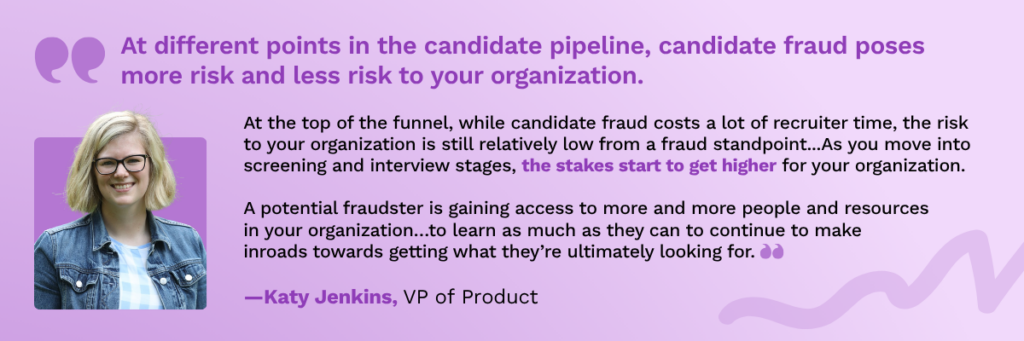
But defaulting to heavier safeguards can do more harm than good. Fraud prevention shouldn’t get in the way of great candidates. Instead of hardening the entire process, teams need to apply protection thoughtfully—scaling it as risk increases.
Early in the process: Requiring ID verification at the application stage may seem like a simple way to prevent fraud, but it can introduce friction and deter real candidates—especially those from underrepresented groups who may be hesitant to share such personal information so early in the process. A better approach is to use well-placed screening questions to catch obvious risks early— helping teams filter out low-intent applicants, better understand real capabilities, and flag potential fraud—without limiting access to qualified talent.
As candidates move forward: Shift to validation. Ask candidates to walk through their work in their own words. Watch for consistency across conversations. Put skills to the test in real-time discussions or exercises.
Closer to offer: Identity checks, references, and credential validation protect your team—but timing is everything. Too early creates drop-offs. Too late increases risk.
Ultimately, no single step or signal is enough on its own. It’s the combination of signals across the process—how they align, reinforce, or contradict each other—that gives teams a clearer, more reliable view of what’s real and what’s not. When done right, this layered approach helps organizations spot fraud earlier without overcomplicating the process for qualified candidates.
Balancing Innovation and Protection
As AI continues to evolve, and bring with it new possibilities for TA teams, so too will candidate fraud.
The same technologies that help recruiters move faster, surface stronger matches, and reduce manual workload are also lowering the barrier to more sophisticated deception. In short, the landscape is shifting on both sides.
But that doesn’t mean pulling back from innovation. It means implementing it responsibly.
Forward-thinking teams are approaching AI with dual intent: accelerate hiring performance while reinforcing trust. That requires governance, transparency, and safeguards designed to keep humans firmly in the loop.
In practice, that looks like:
- Defining clear AI use cases tied to measurable hiring outcomes—not adopting tools for novelty.
- Maintaining human checkpoints at critical decision moments to validate context and judgment.
- Layering verification steps so scrutiny increases as risk increases.
- Establishing transparent candidate communication around where and how AI is used.
- Documenting governance policies that outline accountability, bias monitoring, and audit readiness.
Innovation without oversight creates risk. Protection without innovation creates stagnation.
The opportunity for TA leaders in 2026 is to do both: leveraging AI to improve speed and signal, while embedding layered defenses that protect people, data, and brand integrity at every stage of the funnel.
Innovation, Done Right
The 2026 Recruiter Success Kit brings together the strategies, worksheets, and practical frameworks TA leaders are using to align innovation with outcomes, protect their hiring funnel, and prove ROI along the way.
Download the full kit and unlock your blueprint to better hiring.
The post The New Hiring Equation: Speed, Signal, and Safeguards first appeared on Jobvite.